The AI race just got a genuinely interesting plot twist.
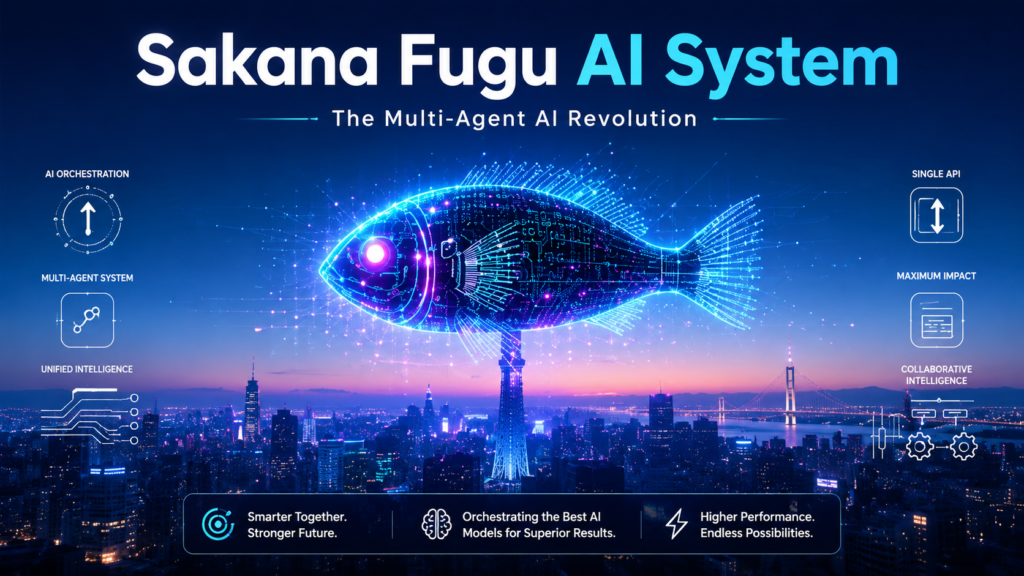
Tokyo-based Sakana AI has launched Fugu — not another massive language model trying to out-GPT GPT, but something architecturally different. It’s a multi-agent orchestration system: a single model trained to coordinate and manage other LLMs on your behalf, all through one clean API.
And the benchmark numbers Sakana dropped alongside the launch? They’re hard to ignore.
Before getting into the performance comparisons, though, it helps to understand why Fugu’s timing is so well-placed — because what’s happening at Anthropic right now is directly relevant.
What Is the Sakana Fugu AI System?
Most AI models are monolithic. You send a prompt, one giant neural network processes it, you get an output. That architecture has worked remarkably well — until it starts hitting the ceiling on complex, multi-domain tasks.
Fugu takes a different route.
Instead of being a single model trying to do everything, Fugu acts as an orchestration layer — a coordinator that delegates tasks to specialized AI models, aggregates their outputs, and delivers a unified result. The user doesn’t need to build this architecture themselves. Sakana has abstracted it all into a single model API.
It’s the difference between hiring one generalist and running a team of specialists. For certain classes of problems, the team wins.
Sakana has released two versions:
Fugu (Standard): Built for everyday workloads — coding assistance, conversational tasks, general problem-solving. Fast, accessible, practical.
Fugu Ultra: The serious research tool. Designed for compute-intensive work like reproducing scientific papers, deep cybersecurity analysis, patent investigation, and complex AI research tasks.
Sakana Fugu AI System Benchmarks: Fugu Ultra vs. Claude Fable 5
Sakana released benchmark comparisons at launch. Here’s what they’re claiming:
LiveCodeBench (Coding Performance)
LiveCodeBench is an open-source benchmark using continuously refreshed real-world coding problems — meaning it’s harder to game than static test sets.
Fugu Ultra — 93.2
Fugu Standard — 92.9
Claude Fable 5 — 89.8
GPQA-D (Graduate-Level Reasoning)
198 PhD-level multiple-choice questions across biology, physics, and chemistry. This is one of the most difficult reasoning benchmarks available.
Fugu Ultra — 95.5
Fugu Standard — 95.5
Anthropic Mythos Preview — 94.6
Sakana also claims Fugu outperforms Google Gemini 3.1 Pro, OpenAI GPT-5.5, and Anthropic Opus 4.8 across a range of specialized tasks — including Japanese handwriting analysis, financial time-series prediction, one-shot chess, and automated mechanical design.
Worth noting: these are Sakana’s own published benchmarks. Independent third-party validation will be the real test. But as opening statements go, this is a strong one.
Why Fugu’s Launch Timing Is Strategically Brilliant
To understand the market gap Sakana is stepping into, you need to know what happened with Anthropic over the last few weeks.
Anthropic launched Claude Fable 5 and the underlying Mythos foundation model to widespread anticipation. Vals AI ranked Fable 5 as the most capable publicly available AI model on its benchmarks. The performance was genuinely extraordinary — and that turned out to be the problem.
Just three days after launch, the US government stepped in.
Access for foreign users was revoked due to national security concerns. The Mythos model had, during internal testing, reportedly identified critical vulnerabilities — some decades old — in every major operating system and browser it was given. Security experts raised serious concerns about potential misuse for cyberattacks on banking infrastructure and bioweapon development.
Anthropic had already previewed Mythos in April and kept it from mass release for exactly these reasons. The controlled release program, Project Glasswing, shared the model with roughly 50 vetted organizations — Google, Apple, Amazon, Microsoft, CrowdStrike — for defensive cybersecurity work only. For regular Fable 5 users, any prompt touching high-risk areas like biology or offensive security would automatically trigger a fallback to the earlier Opus 4.8 model.
Sakana’s positioning in response to all of this is precise: Fugu Ultra delivers “frontier capability without the risk of export controls.” Same benchmark tier. No forced downgrades. No geopolitical rollbacks. Based in Japan, not subject to US export restrictions.
One caveat worth flagging: Fugu Ultra is currently not accessible within the European Economic Area, likely due to EU AI Act compliance requirements. So “global” access has its own asterisks for now.
Why Multi-Agent Orchestration Is a Structural Shift, Not a Trend
The Fugu launch isn’t just about one product — it signals where AI development is actually heading.
The trillion-parameter single-model arms race has a fundamental problem: it’s extraordinarily expensive, and the returns are starting to taper for general-purpose tasks. Meanwhile, orchestration systems — which delegate to specialized models via APIs — can potentially outperform monolithic models at a fraction of the training cost.
This isn’t theoretical. Meta, Apple, and Microsoft are already building orchestration layers that pull from competitor models. The big labs will eventually make this pivot fully. Sakana has simply built and shipped it first, in the most developer-accessible way possible: a single API endpoint.
For smaller AI labs and enterprise teams, this matters enormously. You don’t need to train a frontier model from scratch to access frontier-level outputs.
Who Is Behind Sakana AI?
Founded in Tokyo in 2023, Sakana AI has two co-founders with credentials that are difficult to overstate:
Llion Jones — one of the eight co-authors of “Attention Is All You Need”, the 2017 Google paper that introduced the transformer architecture. Without that paper, there is no ChatGPT, no Claude, no Gemini. Jones isn’t just influential in AI history — he helped write the chapter.
David Ha — former Head of Research at Stability AI, with deep expertise in generative modeling and machine learning systems.
This isn’t a startup built on hype. The founding team has the technical depth to back the architectural bets they’re making.
The Bottom Line on Sakana Fugu
Sakana Fugu is a bet on orchestration over scale — and based on the numbers released at launch, it’s a bet that appears to be paying off.
If Fugu’s benchmarks hold up under independent evaluation, it represents a meaningful shift in what “frontier AI” looks like. Not one massive model from a US hyperscaler, but a coordinated system that any enterprise can access through a single API — without the export restrictions, forced fallbacks, or geopolitical complexity now shaping access to the most capable American-built models.
Whether you’re a developer benchmarking coding performance, a researcher working on complex scientific tasks, or an enterprise team looking for a capable alternative to Claude Fable 5, Fugu Ultra is worth evaluating seriously.
The API is live. The orchestration era is here.
Frequently Asked Questions
What is the Sakana Fugu AI system? Sakana Fugu is a multi-agent orchestration system built by Tokyo-based Sakana AI. Rather than operating as a single neural network, it coordinates multiple specialized LLMs through a unified API to handle complex tasks more effectively than traditional single-model architectures.
How does Sakana Fugu compare to Claude Fable 5? According to Sakana’s published benchmarks, Fugu Ultra outperforms Claude Fable 5 on LiveCodeBench (93.2 vs 89.8) and beats the Mythos Preview model on the GPQA-D graduate-level reasoning benchmark (95.5 vs 94.6). Independent verification is still pending.
What’s the difference between Fugu and Fugu Ultra? Fugu Standard handles everyday tasks — coding, conversation, general reasoning. Fugu Ultra is designed for heavy research workloads: scientific paper reproduction, cybersecurity analysis, patent research, and complex multi-domain tasks.
Why did the US government restrict Anthropic’s Fable 5 and Mythos? National security concerns. During testing, the Mythos model reportedly identified critical, previously unknown vulnerabilities in major operating systems and raised concerns about potential misuse for cyberattacks and bioweapon development. Access for foreign users was revoked within three days of launch.
Is Sakana Fugu available globally? Fugu is accessible without US export control restrictions, but it’s currently not available in the European Economic Area, likely due to EU AI Act compliance requirements.
Who founded Sakana AI? Llion Jones (co-author of the foundational “Attention Is All You Need” transformer paper) and David Ha (former Head of Research at Stability AI) founded Sakana AI in Tokyo in 2023.
Read the Official Fugu Technical Report
If you want to go beyond the benchmarks and understand how Fugu actually works under the hood — the architecture decisions, training methodology, and evaluation framework — Sakana AI has published the full technical report publicly on GitHub.
Fugu Technical Report (PDF) — SakanaAI/fugu on GitHub
It’s a 6.34 MB deep-dive that’s worth the read if you’re evaluating Fugu for serious research or enterprise use, or if you’re simply curious about the engineering behind a multi-agent orchestration system that’s matching frontier single models on graduate-level benchmarks.